Leadership Philosophy
My Leadership Philosophy
I believe that effective leadership in early childhood education is built on trust, collaboration, and ethical responsibility. As a leader, I strive to create a supportive environment where educators feel respected, listened to, and confident in contributing their ideas and strengths.
I practise collaborative leadership by encouraging open communication, shared decision-making, and reflective dialogue. I recognise that meaningful improvement happens when leaders model integrity, remain open to feedback, and take responsibility for their own growth.
Through purposeful planning, empathetic engagement, and continuous reflection, I aim to strengthen instructional quality, operational effectiveness, and staff well-being in every centre I serve.
How My Leadership Philosophy Was Developed
My leadership philosophy has been shaped through formal training, reflective practice, and hands-on experiences in managing instructional, operational, and interpersonal challenges. Each stage of my professional journey has deepened my understanding of leadership as both a responsibility and a learning process.
The following artefacts reflect my growth across the PDC1 and PDC2 modules and illustrate how theory, practice, and reflection have informed my leadership approach.
Artefact 1 (LEDS)
Type: Individual Reflective Journal
Module: Leading Self (LEDS) – PDC1
📖 Context
This artefact is an individual reflective journal completed as part of the LEDS module. It documents my learning journey in developing self-awareness, emotional regulation, and ethical responsibility as a leader.
🌱 Leadership Learning
Through this journal, I became more aware of how impulsiveness, unmanaged emotions, and unexamined assumptions can affect professional judgement and relationships. The reflection activities helped me practise reframing my mindset, prioritising issues thoughtfully, and exercising self-control in challenging situations.
I also learnt the importance of “realistic optimism” and sustainable self-care in maintaining professionalism and resilience.
📈 Impact on Practice
As a result of this learning, I became more intentional in pausing before responding to workplace challenges, seeking constructive dialogue, and managing stress responsibly. This has enabled me to maintain ethical conduct, communicate more effectively with colleagues, and model emotional regulation for children and educators.
🪞Reflection
This reflection demonstrates my commitment to continuous professional learning. Through structured reflection activities, I examined my leadership strengths, areas for improvement, and professional values.
The process encouraged me to critically evaluate my practices and align them with ethical and collaborative leadership principles. It also reinforced the importance of lifelong learning in maintaining relevance and credibility as a leader.
This experience deepened my understanding that leadership growth requires intentional reflection and openness to change.

Artefact 2 (Monitoring System)
Type: Informal Planning and Tracking System
Module: VIPC - PDC2
Artefact 2 (Monitoring System)
Type: Informal Planning and Tracking System
Module: VIPC – PDC2
📖 Context
In managing multiple responsibilities and centre tasks, I developed a personal monitoring system using dated notes and visual reminders to track priorities, deadlines, and follow-up actions.
🌱 Leadership Learning
Through this practice, I learnt the importance of maintaining visibility of tasks and systematically reviewing progress. This approach reflects VIPC principles of aligning daily actions with organisational goals and maintaining accountability.
📈 Impact on Practice
This system enabled me to manage competing demands more effectively, ensure timely follow-ups, and reduce oversight. It strengthened my ability to coordinate tasks, support colleagues, and sustain operational continuity.
🪞Reflection
This monitoring system reflects my approach to self-leadership and accountability. Instead of relying solely on external supervision, I developed my own method of tracking tasks, priorities, and professional commitments through dated notes and visual reminders.
This system helped me remain organised, responsive, and proactive, especially when managing multiple responsibilities across centres. It strengthened my discipline in following through with decisions and reinforced my belief that effective leadership begins with personal responsibility.
Through this practice, I learnt that consistency and self-awareness are essential in sustaining professional standards.

Artefact 3 (Staff Schedule)
Type: Staff Scheduling and Deployment Plan
Module: Operational Leadership in Practice (OPLP) - PDC2
📖 Context
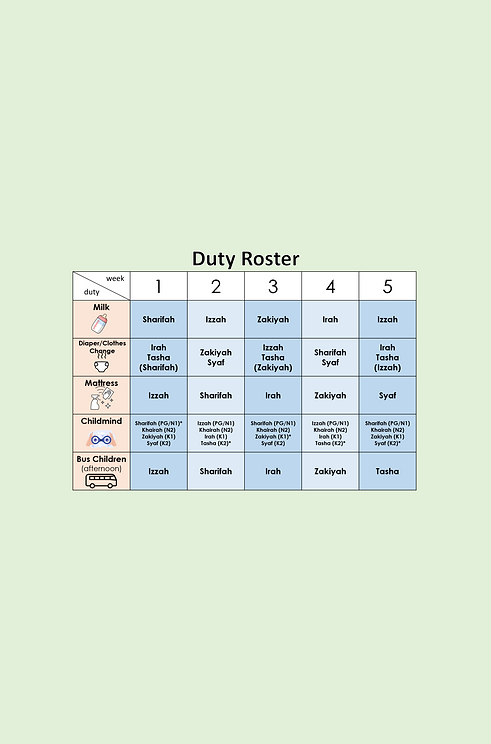
This artefact is a staff scheduling and deployment plan developed to ensure operational continuity, safety, and equitable workload distribution in the centre. The roster was designed to support daily programme delivery while considering staff well-being, regulatory requirements, and organisational sustainability.
🌱 Leadership Learning
In developing this roster, I applied operational leadership principles by establishing clear structures and predictable routines. Key considerations included:
-
Ensuring school-attending teachers were not assigned closing shifts to support work-life balance
-
Implementing a three-shift system (7am, 8am, 9am) with two teachers per shift
-
Maintaining two staff members during opening and closing hours to ensure safety and accountability
-
Excluding non-programme staff from teaching rosters to maintain professional responsibility
-
Planning a ten-week rotational cycle to prevent repeated scheduling patterns and workload fatigue
-
Incorporating flexibility for surplus staff through adjusted reporting times
This systematic approach reflects OPLP principles in manpower planning, risk management, and resource optimisation.
📈 Impact on Practice
The structured roster enhanced operational stability and reduced last-minute disruptions. The mid-shift (8am) functioned as a buffer, enabling timely adjustments when unforeseen circumstances such as staff absence occurred. This supported consistent programme delivery and strengthened team confidence in daily operations.
Additionally, advance planning improved staff preparedness and promoted shared accountability, as expectations were communicated clearly and reviewed regularly.
🪞Reflection
This staffing schedule reflects my commitment to fairness, transparency, and operational effectiveness. The roster was designed to balance staff welfare, student safety, and centre needs through systematic rotation and advance planning.
By ensuring adequate coverage during opening and closing shifts, maintaining consistent staffing patterns, and planning for contingencies, I aimed to minimise disruptions and promote teamwork.
This experience taught me the importance of structured planning, clear communication, and empathy in managing human resources responsibly.
Artefact 4 (PIP)
Type: Classroom Observation and Improvement Plan
Module Link: Instructional Leadership & Coaching (PDC2)
📖 Context
This artefact documents a classroom observation and structured feedback session focused on instructional clarity, student independence, and classroom resource management. The observation identified areas requiring refinement in instructional delivery and learning support structures.
🌱 Leadership Learning
The feedback highlighted the importance of delivering succinct and purposeful instructions to support children’s independence. It also emphasised the need to ensure classroom readiness (e.g., sufficient writing tools) to maintain programme efficiency.
Through this process, I gained deeper awareness of how instructional communication and environmental preparation directly influence student engagement and learning outcomes.
📈 Impact on Practice
Following the observation, I made deliberate adjustments to streamline verbal instructions, model expectations more clearly, and conduct pre-lesson resource checks to prevent operational delays.
These changes contributed to improved classroom flow, clearer task understanding among children, and enhanced learning independence.
🪞Reflection
This Performance Improvement Plan demonstrates my instructional leadership and coaching approach. Through structured observation and feedback, I supported teachers in strengthening classroom management, instructional clarity, and programme delivery.
Rather than focusing on shortcomings, the PIP emphasised professional growth, practical strategies, and reflective improvement. It also strengthened my ability to conduct objective evaluations while maintaining positive working relationships.
This experience reinforced my belief that effective coaching builds confidence, competence, and long-term professional commitment.

Integration of Leadership Learning
Together, these artefacts reflect my development as a reflective, collaborative, and accountable leader. Through self-leadership development, systematic monitoring, operational planning, and instructional coaching, I have strengthened my ability to balance organisational expectations with empathy and professionalism.
These experiences have reinforced my belief that effective leadership requires both structure and understanding. They continue to guide my practice in supporting educators, strengthening learning environments, and sustaining centre effectiveness.
Professional Commitment
Moving forward, I remain committed to continuous professional learning, honest self-reflection, and collaborative engagement. I will continue refining my instructional, operational, and relational practices to better support children, families, and educators in evolving early childhood contexts.
I view leadership as an ongoing journey of learning, responsibility, and service, and I am dedicated to growing alongside the communities I lead.